
Grades 6-8 Toolkit: Pollinate the Planet - Bees
Welcome to our Pollinate the Planet - Bees Toolkit
Whether it’s keeping our crops growing, pollinating the flowers in our gardens, or creating the honey that flavors our favorite sweets – all around us are bees, an almost invisible world that keeps so much of our human word buzzing along. But how much do you know about bees? Do you know that they can carry their entire body weight in pollen? Or that some perform a special “waggle dance” that can precisely tell their hive where a field of flowers is relative to the angle of the sun? Or that, besides the famous honey and bumble bee, there are over 20,000 different species of bee around the world?
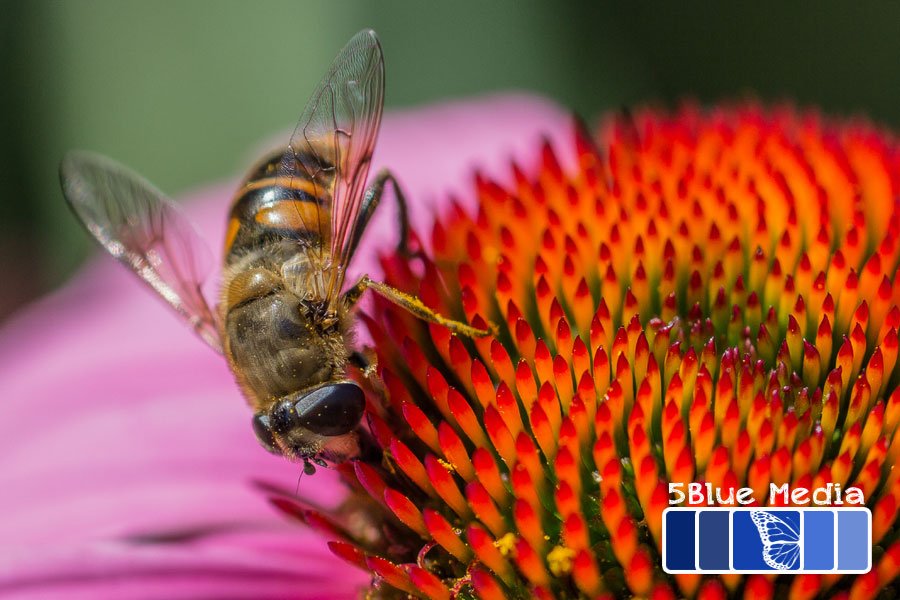
Photo by Eric Weber, Inspire EdVentures and 5 Blue Media
In this toolkit, we’ll be diving into the science of bees, their fascinating behaviors and biology, and why they’re so important to not just our natural ecosystem but also the global food chain that puts groceries in our supermarkets and food on our tables.
To get started, watch this short video on bees:
What’s Covered in this Toolkit?
This toolkit will include interactive exercises, videos, activties,and more to keep your students engaged, while explaining the intricacies of our interconnected human and natural worlds through the eyes of bees.
A story that introduces the science of Belize to your students. This story, and associated vocabulary exercies, may be downloaded as a reading exercise that engages your students. Include are videos and photos taken from a teaching apiary in Illinois.
A 3 minute video that includes important information about bees from expert bee keepers.
A video from our virtual tour series that gives an introduction to bees and the science of beekeeping. This exercise includes comprehension questions for students. Included are talking points to ask your students about the video to ensure comprehension.
Hands on STEM and STEAM exercises that have students learning about the science and business of beekeeping
An Ask A Scientist feature that allows you to get answers for you or your students!
Alignment with Grade 6-8 Science Standards
Coming Soon! Alignment to NC and IL science standards.
We can align our content to any state’s standards, or individual program requirements. Just contact us at michael@inspire-edventures.com for more information
The Story Starts Here
Buzzing over a field in the Midwest United States, a solitary Apis mellifera - or Western Honey Bee - spots a patch of flowers gently tended to behind a suburban house. Quickly, she (and it is always a she!) touches delicately down on one of the flowers, rapidly inserting her tongue into the nectar within to sip at the nutritious, sugar-rich liquid. Immediately, the rapid fluttering of her wings, which creates her famous buzzing sound, creates an electrostatic charge that attaches the flower’s pollen to her specialized leg hairs. The feeding only takes a few seconds – then she’s off to the next flower, and the next, collecting nectar and pollen to bring back to her hive. This three-week-old worker bee might visit 500 to 1000 flowers in a single day.
Once she’s full of nectar, and covered in pollen (up to her entire body weight, in fact), she’s off to the hive, which could be miles away. Carrying this amount of weight is hard work, so her body taps into the special nectar sack (also known as a honey stomach) she’s been filling up bit by bit with each flower. When needed, she can transfer a bit of the high-energy liquid into her stomach. As she finally reaches the nest, she transfers her nectar by mouth to another worker bee waiting just inside, who then repeats the process down the hive. Each passing off introduces a special enzyme, known as invertase, that breaks down the sucrose (a sugar) in the nectar, helping turn it into honey, which is then carefully deposited into honeycomb structures in the hive itself.
The nectar and pollen our little worker bee collects is the lifeblood of the hive. The pollen and nectar will be mixed together to create bee bread, a highly nutritious superfood used to feed newly hatched bees – as well as the male drone bees and the queen that spend most of their lives in the hive. The honey, meanwhile, will keep the hive fed during the cold oncoming winter, when the bees hunker down and feast on their hard-earned reserves. Because a hive needs up to 100 pounds of pollen per season to feed all its bees, knowing where a particularly good patch of flowers is is vital. Luckily, our bee has a special trick to show her sisters just where to go.
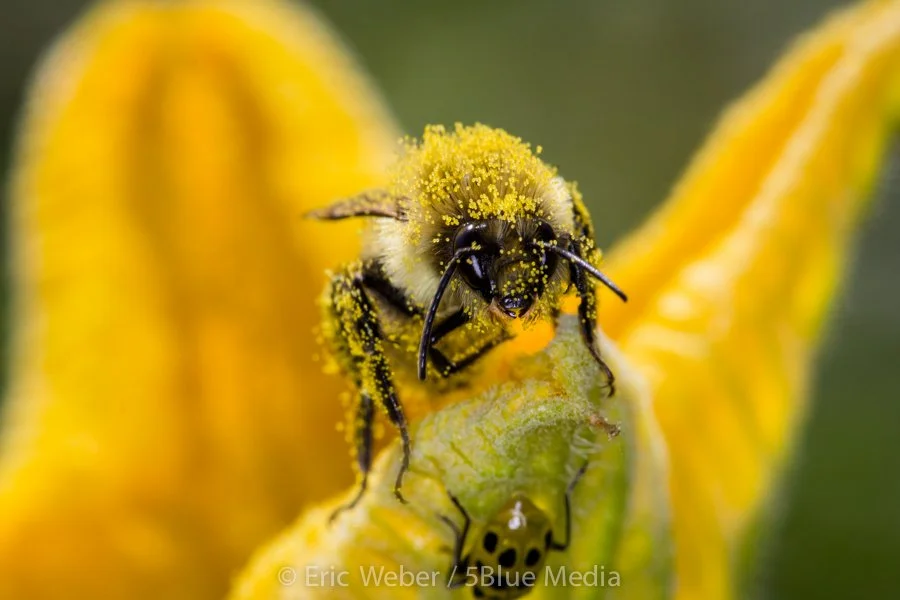
Photo by Eric Weber at Inspire EdVentures and 5 Blue Media
Quickly, she runs up the length of the bee hive, then doubles back, forming a figure eight pattern. As she performs this special waggle dance, how intensely she waggles her abdomen shows the quality of the nearby food source, while the duration of her waggle shows how far away it is (on average, one second of waggling = about ½ mile away from the hive). As she runs straight on this figure eight, the angle of her abdomen shows where the food source is – incredibly, relative to the angle of the sun in relation to the hive!
Soon, she’s back out again, a small swarm of her sisters in tow, on her never-ending mission to keep the hive fed and healthy.
The Ecology of Bees
When we think of bees, we often think about honeybees, one of seven species of bees that form hives and produce honey in them. But there are in fact over 20,000 species of bees around the world, each of which have carved out their own species niche in our global ecosystem.
You don’t need to know all the species (even a bee scientist probably can’t name all 20,000!), but they largely fall into seven families. The ones you are most familiar with are Apidae (honeybees and bumblebees), but you might also recognize Anrendindae (miner bees that nest in the ground), Halictidae (sweat bees attracted to the salt in your sweat) and Megachilidae (which includes leafcutter bees and mason bees, which use leaves and mud, respectively, to build their nests).
Honeybees and bumblebees are what are called eusocial bees,meaning that they live in communities. Not all bees are eusocial – some like mason bees and carpenter bees are solitary, meaning that each female lays her own small nest rather than sharing her home with hundreds of her sisters.
For our social bees, though, division of labor is important. At the top is the queen – she’s the one who lays the eggs, and mates with drones, male bees whose sole purpose is to mate to produce more eggs (if this doesn’t sound like a bad job, remember that they usually die soon after). And then there are the worker bees – the bulk of the hive, exclusively infertile females, that collect honey and pollen, tend to the nest, feed the young, and more. They’re what keeps the hive going, though they usually don’t live more than a few weeks.
But what happens when the hive gets too big? Well, the queen moves out! Taking with her a small collection of drones and worker bees, she leaves to found a new hive in something you’ve maybe seen before - a swarm of bees collecting on a tree. With the queen gone, the worker bees feed a special royal jelly to some of the larvae, who will grow into queens themselves. But as everyone knows, there can be only one queen, so the newly hatched queens fight amongst themselves until one one is left standing. Then the cycle begins anew.
Story Downloads & Vocabulary Worksheets
Download the reading above to allow your students to read the story offline. Our vocabulary worksheets are designed to help with vocabulary-building exercises using the boldfaced words in the story above.
PDF version of the story - download and print for individual student work
Vocabulary list - includes definitions
Vocabulary activity - Word Search
Additional Vocabulary-Based Activities (STEAM) - mock interviews and drawing comic strips
A Tour of an Apiary Video Activity
This upcoming feature includes 40 minute tour of the Alderman Lane Apiary in Petersburg, IL by Dave Cox, one of the co-founders of Inspire EdVentures. During this experience you will be able to learn more about bee biology and beekeeping from an expert beekeeper and scientist.
Activities for the Video (Coming Soon!)
Talking Points
Managing an Apiary Activities
These activities have the students have students apply math and analytical thinking skills to understand the economics of designing and running an apiary.
Handouts for the Apiary Activity
Teacher Resources
Ask A Scientist. A new feature that lets teachers and students ask a real scientist their questions about bees.